Sunday, December 7, 2008

Some travel


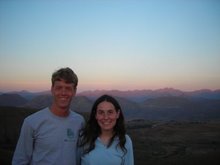
Hey, quick post here. I am leaving for some travels here over the next few weeks so I might not be posting as regularly. Just wanted to leave you with some views from around here. The sunset picture with the city in it was taken from my yard the other night with a couple of big thunderstorms passing us by. The other two were taken just across the border in the Free State province of South Africa and were taken from the top of a small mountain a couple of friends and I climbed. If you look carefully, parts of Maseru are visible in the background of the one with all the farmland. Have a safe December and I will be in touch!

Thursday, December 4, 2008

Public Spotlight

So I went to the grocery store, as I often do on Thursdays because it is the day one of the two weekly English-language newspapers comes out. So in addition to my fruits and veggies, I catch up on the latest goings on here and what a smattering of English language news sources from around the world have decided is important (they run stories from the Guardian (UK), Yahoo (US), BBC, Reuters, South African papers). It is always interesting. Today's issue was very heavy when I picked it up--the paper averages about 45 pages--4 or 5 in Sesotho, 10 on random business stuff cribbed from other sources and a bunch of pages announcing government contracts in addition to a few pages of local news and sport. Getting home I wondered if it was full of Christmas adds (despite the 80 degree plus Fahrenheit temperatures we have been having with lots of big summer thunderstorms), but I quickly realized it was the start of a different season here: exam result season.
Sitting in every newspaper purchased (for five rand...about 50 US cents), was a 130 page supplement that showed the results of the Primary School Leaving Exam. Every student in the country, every school in the country, listed in black and white for every other person in the country to examine. This was just the results of those who finished their 7th (and final) year of primary school. The other students who have to take the big, high-stakes exams (those who finished their 3rd year of high school--basically sophomores--and those seniors who finish high school) will also get the same royal, or ignominious, treatment when their results are announced in the New Year. Now there are some advantages to the system--I could check and see how the children of my friends who were finishing primary did this year, right down to the individual subjects (they show the results for English, Sesotho, Science, Social Studies and Math for primary), which was nice, so I can congratulate her next time I see her. And you can check to see which schools are not getting very many students to pass. I know students use these numbers to see which schools they want to attend to get the best results and parents peruse it to see which school is going to best serve their children.
But in another light, it assumes that all schools and students are equal and by pasting the results there for all to see, the students and schools who didn't do as well are there too for everyone to see and potentially criticize. Is it really fair to compare an English-medium primary school in Maseru whose students are children of government ministers, whose school has running water and electricity and access to internet and all the modern amenities Americans would expect from a primary school to a small mountain primary where the students come part-time when they aren't herding animals, that has no electric, possibly a communal tap for water if they are lucky and is hours on foot from the nearest post office, not to mention telephone service or internet access, which struggles to recruit qualified teachers because it is so remote.
As a once and future teacher I think accountability is important in education, as in any other field, and low-performers need to find ways to bring up the level of education for their students' sake. However, I feel that this particular rite of summer here is one that doesn't necessarily contribute to the furthering of educational aims here. People accept it, however, and even look forward to the results coming out every year. It is great for those who do well (they also publish the Top 10 list of students who got the best average), but I can't help but feel it is a bit unfair. I remain unconvinced on some level that this public shaming of schools and students that are not starting from a level playing field, but are being treated like they are, does some harm. What exactly the harm is I cannot say, but my impression is that it does not encourage those who have not passed to try again for fear of being named two years in a row, publicly, as a failure. There is no rule that says students can't try again next year, but especially for the Primary School exam, this naming and shaming seems a bit harsh.
Sunday, November 30, 2008

Roof of Africa


So this weekend I helped marshal the Roof of Africa, one of the craziest and most technically demanding motorcycle races in the world. My friend Matt and I spent three days hanging out in various scenic spots in Lesotho waiting for the bikes to arrive, helping service crews organize themselves for the arrival of the riders and checking in the bikes when they arrived. It was a long three days, but well worth it. We moved progressively further from town each day into more remote mountain areas. Around 300 riders started on Thursday in the time trial, about 260 started Friday's section and about 120 on Saturday. Some withdrew because of injuries, some because of mechanical failures and others because they had to be able to hit a certain time for the course and couldn't do it. All-in-all, I don't know how many finished, but I can't imagine it was more than about 70. It was a brutally tough race over rocks, mountain passes and through some pretty difficult terrain. These pictures only capture the race around the checkpoints (the easiest and most accessible parts), but believe me, the riders reported some crazy obstacles. Of course it rained for part of Thursday and Friday taking a difficult trail and making it harder. I must say that all the guys are crazy, but at the same time, this is their ultramarathon and I respect them for having the guts to try it and to make it as little or as far as they did. We all have our vices and passions in life and these guys have a particularly wild one!
The winner was a guy from New Zealand who made the rest of the field look like amateurs (which they certainly were not). The best description I came up for his riding was that he rode his motorcycle down the hills like he was skiing, slaloming back and forth as if the bike were a part of his feet rather than a couple hundred pounds of metal. He gapped the field by a wide margin. The pictures on the left show some of the fueling stops with the support crews and a couple of riders I managed to snap photos of as they went by. The one of the rider headed straight down a mountain pass was on the last day of the race as the riders headed into the most difficult section of the trail. It was a mountain pass at 2200 meters (7,200 feet or so) that they crested, checked in and headed back down, only to climb up the pass on the other side of the mountain again! They had completed about 1/3 of the route at that point and still had a long, challenging day ahead of them. Hope everyone had a good Thanksgiving.

Sunday, November 23, 2008

Working at Parliament/Running

So this last week was an intense one spent mainly in the Parliamentary Library. The National Archives sent me over there the other week when they didn't have the records I was looking for. It didn't seem like they get a lot of outside researchers there; in fact, it seemed like it was mainly used by Members of Parliament to do research on previous sessions and to stay current on the Lesotho and South African newspapers. But they were happy to have me sit in there and dig through stacks of Government-published newspapers from 1965 and 66 (the year of independence here). I have probably one day left there of work, but it was an interesting place to sit and work as it is right across a big driveway from the House of Parliament so I got to watch all the comings and goings of top government ministers and MPs while doing my work!

In other news, I traveled yesterday (leaving at 5AM) up to Ficksburg, a small town in South African about 80km (50 miles) from Maseru for their annual Cherry Festival Race. The town is in the middle of the cherry, asparagus and peach growing region of South Africa and the race was brutal! It was 23km (14.5 miles...or almost a mile and a half longer than a half marathon). It started out in town, but about 2.5 miles into the race, turned off onto a dirt/rock/gravel/mud trail that wound its way up and over the mountain that sits right behind town. Someone with a GPS watch told me we climbed over 250 meters in the course of the 5km (3 mile) climb. Then we ran on top of the mountain (more of a plateau really) in a series of ups and downs before dropping the entire 250 meters in about 3km (2 miles), in a part of the race that was especially hard on the legs. Then it was just 6km more (@ 4 miles) back into town. Ficksburg sits at an elevation of about a mile to begin with so this was quite the race. I managed to place 8th overall out of about 700 with an average right around 6 minutes a mile, which seemed pretty good considering. I am a bit sore today, but hopefully that will work itself out pretty soon! It was a good time and I even got to hang out at the Cherry Festival afterwards (think American midwestern county fair-type atmosphere with all things cherry for sale). Good times!

Tuesday, November 18, 2008

Lesotho's waterfalls


In case you were worried that all I do here is work, fear not. Last Saturday I went with some friends up to the mountains (about a 45 minute or an hour drive from Maseru) to hike to the waterfalls that you see pictured here. They are called Qiloane Falls (the Q is the click sound in Sesotho...try it). They are stunning, especially after a week where it rained a few times. The pool at the bottom is excellent for swimming, if a bit cold. However, this being Lesotho, you can just hike right down and jump in as many times as you want (one in my case). The hike to get there, which you see in the third picture was spectacular through the treeless high mountains. It was a quite managable hike (+/- 2 hours) through some spectacular country and a good excuse to get out of the city for a while on a nice early summer day here.

In case some of you are worried because I have not updated on my running in some time, I am still going at it pretty hard. I am planning to run a 23 kilometer race (about a mile a quarter more than a half marathon) this coming weekend in the South African town of Ficksburg, which is on the border with Lesotho about an hour north and east of Maseru. It is a partially off-road, up, around and down a mountain that, like everything else around here is at altitude of at least 5000 feet! I will let you know how it goes. Take care.

Sunday, November 16, 2008

Degrees of separation

Happy weekend to you (even if it is mostly over). I was reminded last week how small and interconnected this country is when I went out for an interview. I had been given the name of a man from one of the other guys I had interviewed who he said would be interesting to contact. So on Thursday I set out for the place where he had told me to go (he said, just go to St. David's mission near the town of Mamathe's and ask for him). Sure enough, I rolled up and knocked on a door and found a secondary teacher who knew exactly where he lived. We walked together down to his house and he sat with me as I interviewed a very nice and informative gentleman who had been active in the Boy Scouts and had taught at various schools in Lesotho for 58 years (58!). At the end of the interview, I mentioned that I had a former teaching colleague who had lived just near here as well and asked if he had known her (she has passed away, this is 'Me Libe for those reading this who know her) and, of course, not only did this man know her, but he had taught with her and her husband at various times in his career. So here I was sitting in a man's house who I had met less than an hour earlier who was 55 years older than me and we had taught with some of the same people. It was a neat situation, a great way to end the interview talking about former friends and a good reminder about how small a country of 1.8 million people (according to the census) really can be.

Lest you think I spend all my time running around the countryside, on Friday I was asked to take part in a round-table discussion at the university on the US presidential elections, the crisis in Zimbabwe and the crisis in the Democratic Republic of Congo. As the collection of topics seemed rather scattered I was a bit nervous about sitting on a panel like that, but it turned out very well (thanks to the skill of the moderator) and was quite interesting with a free-wheeling discussion about African politics, the role of western foreign policy and what should be done to move forward in these situations (not the US, but the others). The university has an interesting staff that gets many professors from around the southern African sub-continent so there was a lively discussion with professors and students (mostly local Basotho) that left me feeling more hopeful that someday there might be enough pressure from 'civil society' to force the hands of regional governments to bring about some constructive change in truly bad situations. Stay well!

Tuesday, November 11, 2008

St. Rodrigue in the news

Hello everyone, I was just informed that the BBC is doing a feature on the area around where I used to teach here in Lesotho, St. Rodrigue. The link is below, but it is a long-term project of theirs to chart how HIV/AIDS is affecting people in the rural communities. It could be a very interesting project, so please check it out at least once. I don't know how often they will be updating it, but you might want to check back in a month or two as well (I will try to keep up with it as well).

http://news.bbc.co.uk/2/hi/africa/7697831.stm

Take care!

ps for those who know St. Rodrigue, I don't know exactly what they have shown on the Google Map at the bottom of the article, but it is not the main mission. It might be one of the clinic outstations (Ha Shoaepane, perhaps?)