Saturday, February 28, 2009

Taking stock


Hello again. About a week ago I passed the 6-month mark of this trip. Summer is starting to fade out a bit here, although the unseasonable rains have made this one of the most comfortable summers I have ever experienced with daytime highs in the 70s and nighttime lows around 50. Good for running, good for work, good for living and the farmers! About the only thing suffering from all the rain is the topsoil which is eroding even faster this year and heading downstream to South Africa and the Atlantic Ocean.
So after another six months living in Lesotho, where do I stand? My work seems to be progressing well. I am gathering together a nice collection of very interesting interviews, most averaging an hour and a half of sitting and chatting. Having invested in a scanner my computer is also filling up with scans of newspapers from the 1950s and 60s along with photographs, election posters, anti-communist literature and other random documents that I happen to come across when I have the scanner and access to electricity. So work, while it does drag at times like when I am trying to get in touch with people who are not easy to track down or when I think about spending another day by myself in the archives digging through dusty boxes of yellowed, musty newspapers, would have to be called a success so far.
Socially, it has been a lot easier to find things to do then I expected coming here to live in a new city where, outside of a few teaching friends who have their own families, I really didn't know anyone. Through a series of fortuitous coincidences and random encounters I have managed to make some pretty good friends here and now keep as busy as I would like. I have also been running a lot, some on my own and some with two different groups--one a group of South African bank employees who are serious marathoners and ultra-marathoners, and the other a group of younger Basotho who are trying to make the jump from decent school runners into the ranks of those who could conceivably compete for cash prizes at some of the road races in Lesotho and South Africa. Both push me in different ways and both are a lot of fun to hit the roads, hills and trails of Maseru with. I will be running a marathon next weekend in South Africa to qualify for the Comrade's Marathon, which is a 56-mile (89 km) race between the cities of Pietermaritzburg and Durban. Needless to say, it is a big undertaking. It will go down in May, a little over a week before I leave to come back to the US.
Of course I still maintain contact with St. Rodrigue (the high school where I used to teach) and some of my oldest friends here in the country come from that connection. So on the whole, while I won't say that the time has flown by all the time, it sure surprised me to realise that I had hit the 6-month mark. I dare say the final three months will go faster as work gets more pressing and my departure date gets closer. Stay well.

Sunday, February 22, 2009

Rain and theories

For much of the spring (September-November), many people in Lesotho were fervently hoping and praying for rain (some of the sisters at the school where I used to teach had gone for a pilgrimage to another mission to pray for rain when I went up there to visit back in August). People need it to loosen up the rock-hard ground after the cold winters here in order to plow and plant. They also need it to water the grass that the ubiquitous cows and sheep feed on. Lesotho is also just a much more pleasant place to live when the hills and mountains are green rather than the dull, dusty brown that comes with winter.
After much delay the rains finally came in mid to late November, about two months late but just barely in time for most people to still get in a decent crop for the year. We had wonderful summer weather for a few months, but in late January, it turned again. Since then we have had a period of fairly intense rain that is somewhat unusual for the region. Full days of rain. For two or three days at a time separated by a day or two of warm sunshine. This part of the world is known for its impressive summer thunderstorms, but not its full days of rain and low gray clouds.
It has made the summer not very hot. Many days here of late we are only getting up to 20 or 22 degrees C (around 70 F). Almost everyone I talk to has said that the rain is unusual and I agree heartily with them. No one can agree on causes, but many people have pet theories ranging from global climate change to the effect of putting two very large new lakes in the high mountains of Lesotho. No matter why it is coming, it has certainly breathed life into the fields of Lesotho and made the rivers, which can run to a trickle or even nothing in the winter, into raging torrents that flow over the low bridges built on the gravel and dirt back roads of Lesotho and take enormous quantities of brown muddy water and the topsoil of this country down into South Africa and eventually the Atlantic Ocean.
Stay well.

Thursday, February 19, 2009

Around Lesotho


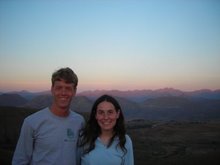
It has been a while since I have posted, but my parents were here for a visit. I don't really have anything profound to write. We had a great visit and it was a lot of fun to show them around Lesotho (it was their first time visiting the country). It rained a lot but that just made the back-country dirt/gravel roads more interesting! Fortunately we were not in my little car, but in something a little more powerful with four-wheel drive. The pictures here are just a few that I took. The stone house is the house of the first King, Moshoeshoe I. It was built in 1839 and is still standing on his mountain fortress, Thaba Bosiu--Mountain of the Night. The rest of scenery pictures. The waterfall is up at Semonkong, the 200 meter tall Maletsunyane Falls and the photo of the three of us shows St. Rodrigue, the school where I taught and which the BBC is currently documenting, in the background. Enjoy the photos and I will try to find something more deep and profound to say in future posts! Stay well.

Saturday, January 31, 2009

Month end

For those who have never lived in places where virtually every person is paid at the end of the month (or at the best, twice a month), there is very little to compare the phenomenon that is month end, especially here in January where many people are short on money because they spent a lot on the holidays. Plus the new school year just started two weeks ago so people need cash to pay school fees (all high schools in the country have tuition fees, books, uniforms, etc that parents ad guardians have to fund).
What does this mean for daily life here in Lesotho? It means that last weekend was a very quiet one in town with precious few taxis full of people speeding towards town. This week was the complete opposite. Everyone from the suburbs around Maseru and even many rural areas have to come into town to use the banks and ATMs to access their cash. So from about Thursday there were enormous lines at all the banks. And by enormous I mean sometimes they stretch for two blocks and people will wait over an hour to use an ATM. Today as I was running through the center of town at 7.30 AM, there were already long queues at all the banks even though they would not open for at least another hour. I guess it pays to get their early and get out. This means that the stores and the shopping areas of town, like the bus station, were also totally packed as people make their necessary purchases.
It is also a time to kick back and relax with friends, so when I ran past a public bar at 6.30 this morning there was already a loud-speaker set up blasting out the local famo music (which is accordion and guitar based with guys singing over the top of a bass riff...I find I don't really mind it unless I am sitting in a taxi with the volume turned up to 11 and the speaker right next to my ear) and people already hanging out. There are always more parties and get-togethers at month end as people can afford to spend a bit more on food and drink.
I can't say that I really like month-end. Going back to my teaching days, riding the bus at month-end was always a unique experience as it was the most crowded (and hot) time as the conductors continued to cram people in long after it was over-full. Now living in Maseru, month-end means there are more people on the roads who might have had a few too many drinks and it is harder to take care of errands as all the stores and offices are more crowded. However, to really experience and understand life here you need to be aware and sensitive to the ebbs and flows of the cash cycle. Sorry I don't have any photos for you this time, but my camera needs batteries and I wasn't going to get in the crush today just to get those!
Stay well.

Wednesday, January 21, 2009

Human nature and diverse experiences

So yesterday I had three very different experiences that sort of sums up the different circles I run in around here. During the day I spent my time in a small village out near the mountain where the first King of Lesotho gathered together a disparate group of individuals and made them into the Basotho people of today offering them shelter and security in a time of great unrest in exchange for loyalty and fighting for him in battle when it was needed. The old men I was interviewing (with the help of a Mosotho friend as my Sesotho language skills wasn't quite good enough for full-length interviews) were both prophets in an African independent church that was formed in the 1920s and takes its name from the founder of the nation, Moshoeshoe. Both of them emphasized during the interview that they are not the ones controlling their message and that Moshoeshoe himself must have had a deeper understanding of religion (ie sent from a higher power) because while he invited missionaries of different denominations into his country (in the 19th century, a time when denominational differences between various Christian groups mattered a lot more than they seem to today in the West), he himself never joined any of the churches. He saw them as useful to his mission and for his people but stayed above them in order to try to preserve peace in his country.
Then in the late afternoon I found myself sweating on the hot streets of Maseru running hill repeats with a disparate group of Basotho ranging in age from late teens to well over 50 who all meet in the afternoons to do some training. It is mostly a junior development running group for aspiring national-class runners, but there are some serious trainers who happen to be older and slower as well. A fun group to train with and the hill repeats certainly burn the lungs and legs at 5500 feet! I try to meet up with them at least once a week to get in a good quality workout and a couple of them might even make it to the St. Louis marathon this year to race in the US.
Finally, I made it with two minutes to spare to a get-together in the backyard of some friends' who were hosting an inaugural-watching party for a group of 30-40, of whom probably 2/3rds were American. We watched the pageantry on the Mall unfold, the excited coming together for the peaceful transition of power and heard a speech that echoed some of the great figures and speeches from the American past.
Doing all these things on the same day may sound like a disparate day of acts not connected, but in all of them, the theme ran through that we are all human and need to treat each other as such and life not only can and will go on, but can improve for all people. All the people I came across were working not only to better themselves but had also come together with others to make life better for a wider circle of people. While I did not understand much of what the prophets of the independent church were saying (even when they were translated into English), some of what my running colleagues were saying in Sesotho or what all the people watching the speech in Washington, Maseru or anywhere else in the world were thinking, it made me reflect that the most powerful acts come from people coming together to understand each other and work for good.
While the news reports of conflicts and death in many places (and ignores others, like the Democratic Republic of the Congo, but that should be another post), only listening to/watching or reading the news can cause us to lose the human perspective--that everyday throughout the world, people are coming together to better understand each other and work for good. It isn't reported in the news, but it is what makes the world go on and gets me out of bed in the morning.
Stay well.

Wednesday, January 14, 2009

More Lesotho on the BBC

For those of you who don't have the BBC Africa page bookmarked (and I am in that category as well), they have updated some of their stories from St. Rodrigue, Lesotho--which is the community where I taught high school in 2002. It is a story about how people in rural Lesotho are coping with the HIV/AIDS crisis. It is extremely well written, dare I say beautiful. The link below takes you to the story of a primary school teacher. The other links are on the right side of the page. Only the first four have been updated since the first time I posted this link, but if you haven't checked them all out, please do so.

http://news.bbc.co.uk/2/hi/africa/7806217.stm

Stay well.

Saturday, January 10, 2009

Not so 'funny' money

On a more serious note, on my travels I was right on the Zimbabwean border at Livingstone, Zambia. There the street vendors were selling what you see in the photo as tourist curios. I gave a guy all the Namibian change I had left in my pocket (less than $1) to get this note from him. It is what passes for Zimbabwean currency these days, although if you look closely, you will note that it has already 'expired'. How money can expire is beyond my comprehension, but then so too is money that is worth 50 billion anything. And I didn't have enough change for him to give me the 100 billion note.
It really is a sad commentary on a country that is destructing right now. The Robert Mugabe-led regime in Zimbabwe is currently making a mockery of that country and while I don't know what the solution is, more awareness of the problems the country faces can't hurt. People there are starving and dying of a disease that is easily treatable in a country with working health systems--cholera. International condemnation by 'the west' (aka Britain and the US) has so far backfired in that Mugabe just twists whatever is said to present himself as the victim. I would like to think it couldn't get worse, but it really could. Right now Mugabe can't really govern because he slipped up and let the opposition win Parliamentary elections last March--he most likely lost the presidency as well but delayed the results long enough to rig them. It could get worse if he declares a state of emergency and is able to govern without the small level of checks he (and the heads of the police and army, who currently hold the real power) has now. So, while I don't have an easy solution to the problem, the least I can do is help raise awareness and showing the joke that passes for 'money' right now there is a powerful image.
I don't know if writing Congresspeople, Senators, President-elects, Members of Parliament or whoever your local representatives might be will help, but the least you can do is to not skip another newspaper article about Zim that is buried on page 8 of the local paper and to add your voice to those calling for peaceful and meaningful change there.
Stay well.